

Prone Post
“For the traditional Chinese Boxer the mastery of Fu Wo Zhuang is not optional; it is essential”
THIS BOOK IS FREE TO READ AND INCLUDES EIGHT WEEKS WORTH OF PROGRESSION TABLES TO FOLLOW.
Disclaimer
Please note that the author and publisher of this instructional book are not responsible for any injury or illness, whether minor, major, or fatal, that may result from practicing or teaching the techniques or from following the instructions provided within this book. They are also not responsible for any issues encountered when following any hyperlinks embedded in the electronic book version.
Martial arts training can be dangerous to both you and others if not taught or practiced safely. The routines, techniques, and exercises in this book are not intended to replace the advice or treatment of a healthcare professional. Before beginning any physical or mental training, it is advisable to consult with a healthcare professional and/or a qualified martial arts instructor.
This book is sold for instructional purposes only.
Copyright Warning
@HakkaBoxer reserves the right to be recognized as the author of this work. No part of this publication may be reproduced or utilized in any form or by any means, electronic or mechanical, including photocopying, recording, or by any information storage or retrieval system, without the prior written permission of the publisher or author.
The logos displayed within this publication constitute original design and remain the exclusive intellectual property of @HakkaBoxer. Any reproduction, distribution, display, or derivative use of the logos, in whole or in part, without prior written authorization is strictly prohibited. All rights in and to the logos are reserved, regardless of whether the ™ or ® symbols are used in connection with them.
© Copyright 2025 @HakkaBoxer.
Mastering Fu Wo Zhuang for Duan Quan
Many young practitioners of Duan Quan (短拳 - Short Fist Boxing) devote themselves to forms, repetitive punching drills, and speed work, believing that mastery comes from relentless repetition. Yet even the most diligent student may unknowingly suffer from a hidden weakness: a lack of structural strength.
Without a body that is fully connected, aligned, and resilient, strikes dissipate before reaching their target, the torso collapses under impact, and energy is wasted. This weakness is invisible in normal practice, yet it limits every punch, every elbow strike, every move. Fu Wo Zhuang, which translates to “prone pile” or “prone post,” addresses this silent flaw by awakening the body’s true potential for force, resilience, and martial efficiency.
Fu Wo Zhuang (伏臥樁 - Prone Post / Prone Pile)
伏 (Fu) - to lie face-down/prone
臥 (Wo) - to lie down/recline
樁 (Zhuang) - post, pile, stance (as in 樁功, zhuang gong)
Just like Ma Bu (馬步 - Horse Stance) Fu Wo Zhuang is a cornerstone exercise that has been cultivated for centuries in various traditional Chinese Boxing lineages such as Duan Quan, where compact, explosive strikes and precise mechanics are essential. Its purpose is simple yet profound: to train the body as a single, integrated system, in which every muscle, joint, and bone contributes to the generation and absorption of force.
But whereas Ma Bu targets the lower body and leaves the upper body relaxed and stress free, Fu Wo Zhuang puts the entire body under dynamic tension with the bulk of the work being carried by the upper torso and back, building the resilience and structural integrity that underlies all advanced techniques.
The exercise is deceptively simple. To begin, the practitioner lies prone on the floor, in a push up position, placing the hands opposite each other while bending the elbows to approximately one hundred and twenty degrees. An important point here is that the fingers of the hands point towards each other, or are angled at a comfortable “inward” degree, and the space between the hands should be the same size as the length of one hand when measured from wrist to finger tips as shown in Fig. 01.
The hands are also slightly forward of the normal push up position and therefore not aligned directly below the shoulders, as can be seen in Fig. 02.
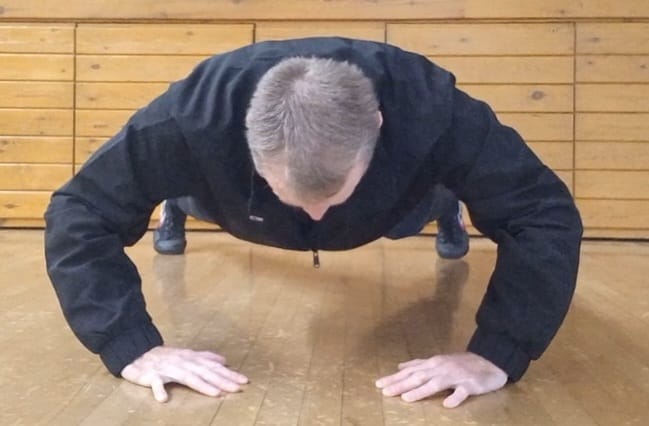
Fig. 01
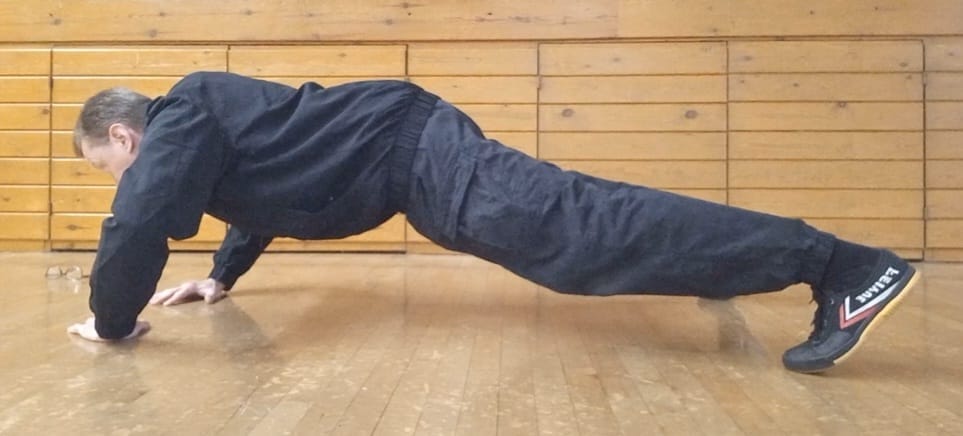
Fig. 02
As per Fig. 01 the feet are spread slightly wider than shoulder width and the body forms a straight line from the top of the head to hips, after that the legs angle slightly towards the heels. The small of the back is gently straightened and the shoulders are pulled down, as if holding a tennis ball under the armpits.
The entire torso is then held in controlled tension. Breathing remains natural, and the mind focuses on the engagement of the trapezius, serratus anterior, latissimus dorsi, pectorals, and core muscles.
Let's walk you through adopting the posture:
First, adopt the push up position, arms straight.
Be sure the feet are spread slightly wider than shoulder width.
Next, rotate the arms so that the hands and fingers point towards each other at a comfortable angle.
Check that the hands have a space between them equal to the length of one hand.
Now concentrate your attention on your lower back. Activate the core and flatten out the small of the back so that the spine is as straight as is comfortably possible for you.
Next, bend the elbows and lower the body just above halfway to the ground.
Flex the muscles of the back as if striking a lat pose. Spread the shoulder blades as if trying to expand the back.
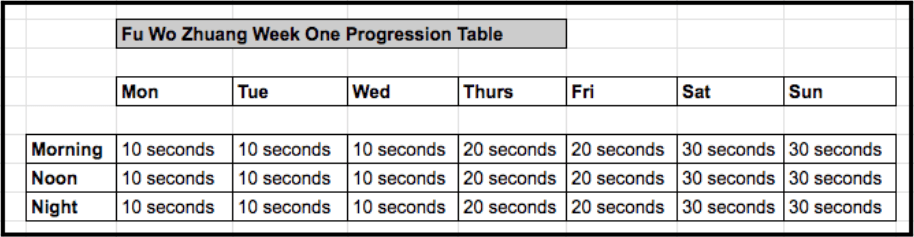
At this stage, beginners should hold the posture for ten to thirty seconds at a time and repeat the practice two or three times daily. The emphasis should be on alignment and body awareness rather than the duration. These short holds will awaken a new understanding of the body: the way tension flows through the shoulders and spine, the connection between hands and feet, and the subtle engagement of muscles that support power.
During the first week, the posture will feel strange and difficult. The shoulders resist sinking, the back may feel soft where tension should be steady, and the ribs seem reluctant to expand. Yet by the end of the week, subtle improvements will have emerged.
The torso begins to recognize its correct form, the back holds without collapsing, and the shoulders settle naturally. The practitioner feels a new steadiness in standing, punching, and moving, the first hint that the hidden weakness is being corrected.
As practice continues, attention shifts from simple alignment to deeper muscular engagement and endurance. The trapezius stabilizes the shoulder blades, the serratus anterior pushes the scapula outward and allows rotational power to flow through the torso, and the latissimus dorsi stretches and powers the arms while shaping the classic inverted-triangle upper body associated with elite striking.
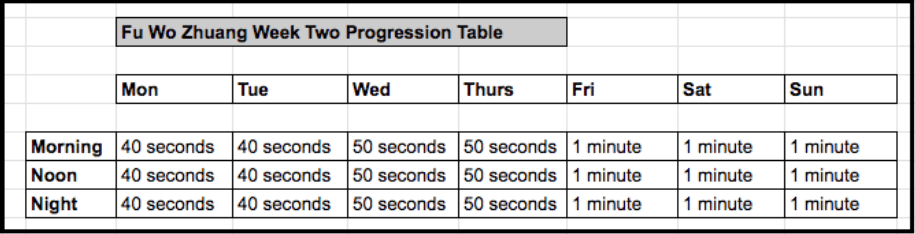
By the second week, hold times increase to one or two minutes, and small adjustments, slight shifts of weight or gentle pressure through the hands, can be used to intensify muscular engagement. Practitioners may begin to notice a distinctive sensation of tenderness between the ribs, indicating that the torso is opening and learning to resist the compressive forces.
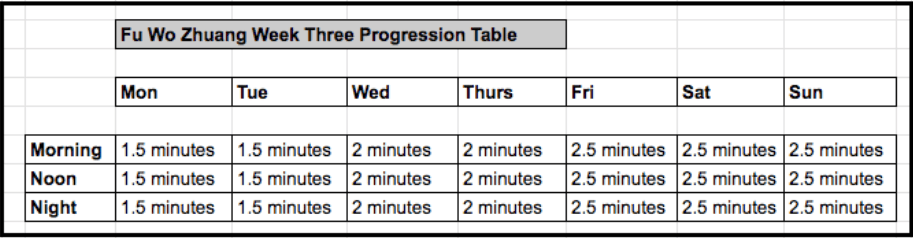
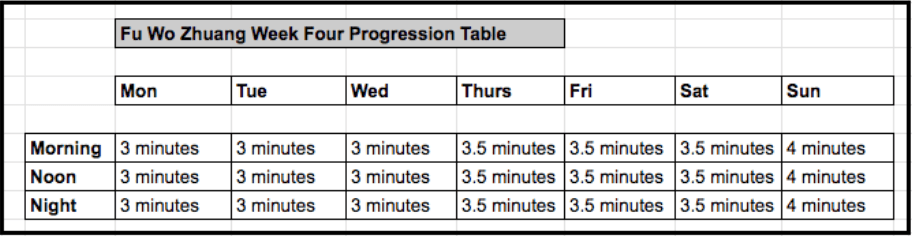
Intermediate practice begins in the third and fourth weeks, when the holds are extended to three to five minutes.
At this point the practitioner may introduce subtle dynamic movements, such as slow circular rocking centered on the shoulders, or visualized strikes, simulating the mechanics of Duan Quan hand and bridge arm applications. As always, the elbows remain slightly rearward, the hands maintain their forward tension against the ground, and the torso functions as a connected, unified line from head to heels.
Complementary exercises, including push-ups or partner administered light impact training, may be added to enhance structural and mental toughness and fortitude. Mental focus becomes increasingly important at this point, as the prolonged isometric holds demand a calm, attentive concentration and controlled breathing. When adding push ups the specific type to be used are those known as Gun Shen (滚身 - rolling-body), which is a type of shoulder and spinal body-rolling drill, or rolling push-up good for torso toughness, whole-body integration, conditioning the ribs, waist, the sides of the body and the shoulders and trapezius muscles.
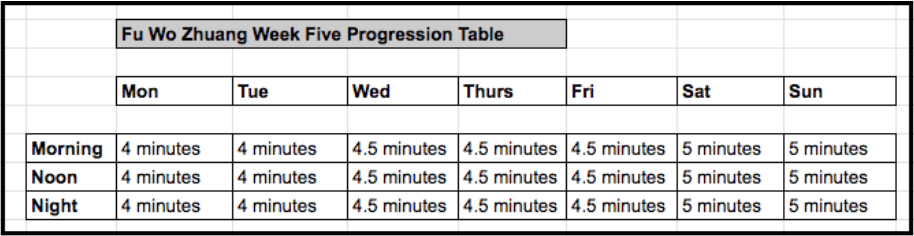
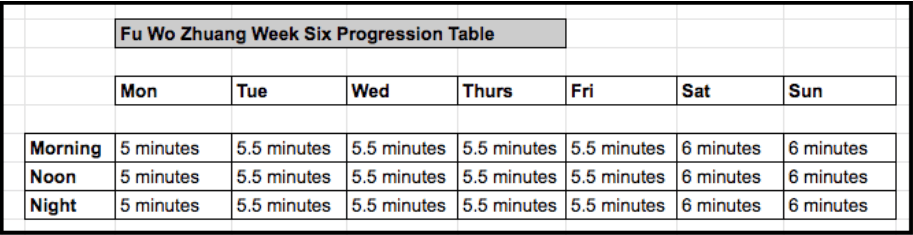
By the fifth and sixth weeks, the body begins to undergo noticeable transformation. The shoulders begin to broaden, the back starts to thicken, and the torso holds tension naturally. Hold times may extend to five or ten minutes, or more, and the practitioner feels a continuous connection between hands, arms, torso, and legs. The subtle rocking or visualization of strikes now becomes second nature, teaching the body to transfer power efficiently while maintaining structural integrity.
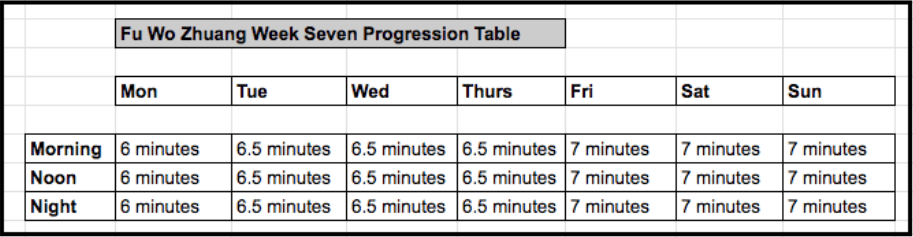
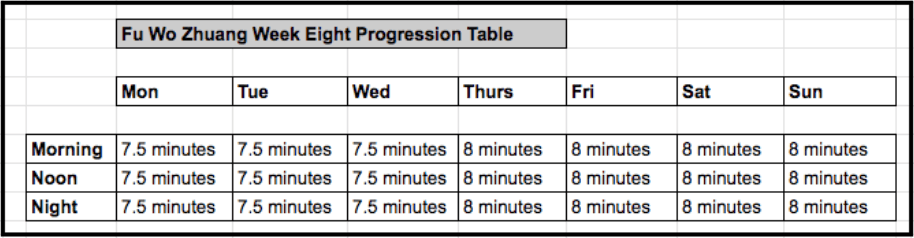
Advanced practice, which unfolds in weeks seven and eight and beyond, challenges the practitioner to sustain holds for five to ten minutes or longer. Full-body tension is maintained, ribs remain open, and the shoulders and elbows rotate slightly to reinforce the structural frame. The mind is calm and attentive, and visualization of Duan Quan strikes is integrated directly into the posture.
Dynamic movement may expand to include short-range push-up type motions with a circular, connected quality, linking the static strength developed in Fu Wo Zhuang to martial technique. The exercise can also be super-set with other full body dynamic tension routines such as San Zhan (三戰 - Three Battles) which will enhance the development of the trapezius musculature of the neck.
By this stage, the practitioner experiences a body that is resilient under impact, capable of generating explosive power, and able to maintain balance and alignment even in the heat of sparring and is now developing the foundation for the Jingang Shen (金剛身 - The Diamond/Vajra Body), a body so fit and healthy that nothing can harm it.
Throughout all stages, safety is paramount. The elbows are never hyperextended, the lumbar spine is supported by subtle core engagement, and the breathing remains relaxed. Complementary mobility work for the shoulders, thoracic spine, and hips enhances fluidity and ensures that structural strength translates into effective martial performance.
Whilst this complementary mobility work consists of routines such as San Zhan it can also include rattan ring drills which will assist with the development of the Dragon Body (龍身 - Long Shen), the wave-like issuance of power through the torso, such as those found in our introductory book “Short Boxing, Short Power”.
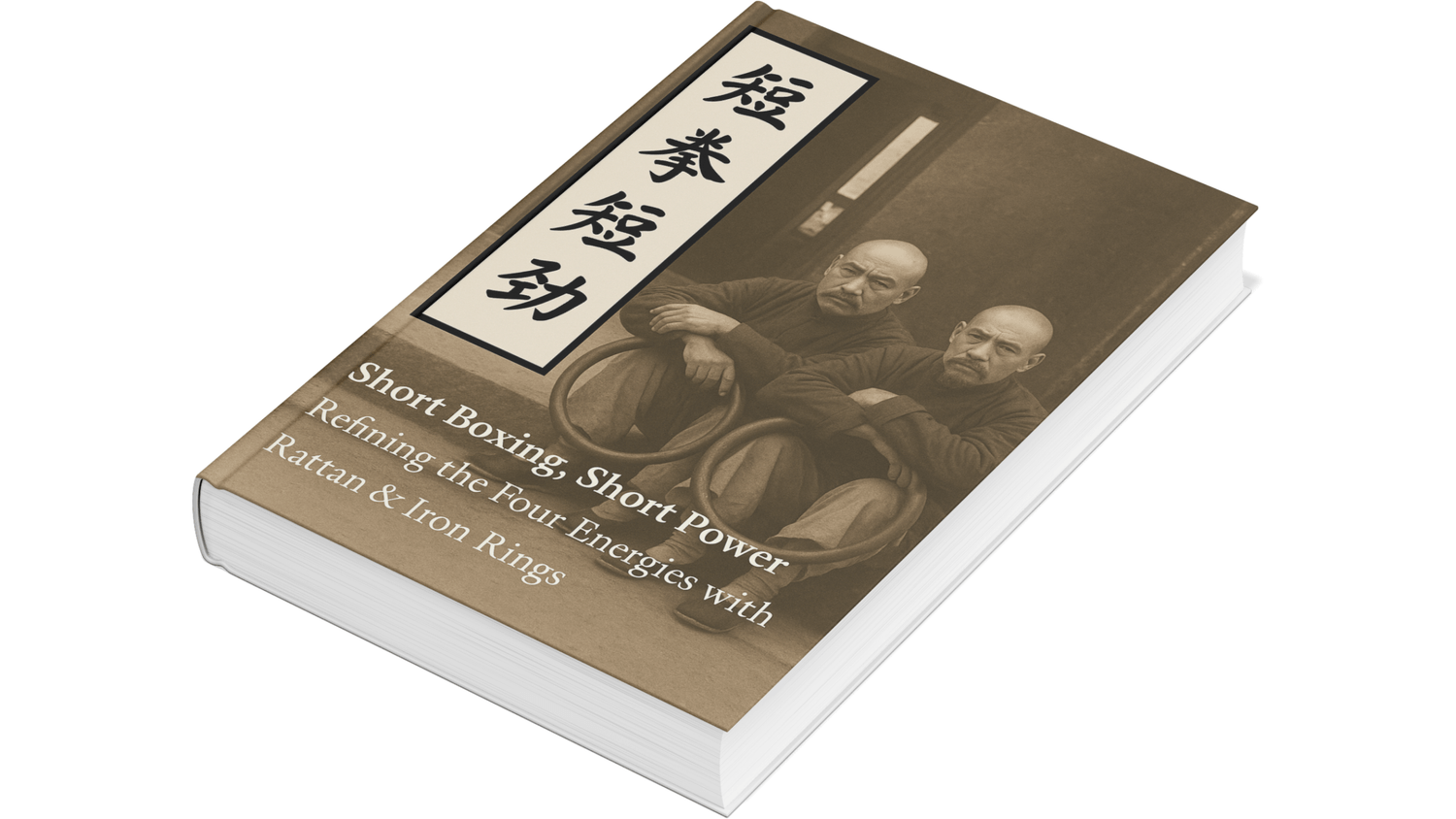
Short Boxing Short Power. Available Soon.
The combined training of trapezius, serratus anterior, latissimus dorsi, pectorals, and core muscles allows for explosive short-range punches, the absorption of incoming force, and the coordination of the body as a single, integrated system.
The benefits of Fu Wo Zhuang extend beyond simple strength or endurance. Over time, the practitioner develops a deep awareness of the body, an ability to sense and correct misalignments, and a mental focus that carries into every aspect of training. The opening of the back and ribs multiplies the effectiveness of strikes, while the integration of shoulders and torso creates a platform for efficient energy transfer.
Consistent practice results in a body that is not only strong and resilient but also capable of delivering compact, rapid strikes with precision. The practitioner learns that power is born not only of speed or repetition but from a body that is structurally sound, dynamically stable, and fully engaged.
Fu Wo Zhuang also teaches the practitioner a lesson beyond the physical: discipline, patience, and attention to subtlety. The progress from short time holds to extended endurance, from static engagement to dynamic visualization, is gradual but profound. Each week brings new sensations, new strengths, and new understanding of the body’s capabilities.
What begins as a humble, awkward posture transforms into a method that empowers every strike, fortifies the torso against impact, and cultivates the body as a single, integrated instrument of force.
For the traditional Chinese Boxer the mastery of Fu Wo Zhuang is not optional; it is essential. It is the foundation upon which explosive, precise, and powerful techniques are built. The journey from awareness to advanced integration strengthens the body, enhances coordination, and cultivates the focus necessary to apply structural strength to martial practice.
In committing to this practice, the student overcomes hidden weaknesses, develops true power, and discovers the quiet, unshakable foundation that underlies all skills in Duan Quan.
Those who embrace this training will find their strikes heavier, their resilience greater under impact, and their understanding of the body more profound. Fu Wo Zhuang transforms the martial body and mind, providing a lifelong tool for growth, mastery, and the disciplined pursuit of martial excellence. It is the practice that turns speed into power, motion into force, and potential into mastery, but it is not the end.
Once the practitioner has established this foundation of hard force, the natural progression is to refine that strength with mobility, fluidity, and the subtle mechanics that elevate such martial power to its highest expression.
The next stage introduces the practice of Long Shen Gong (龍身功 - Dragon Body Skill), dynamic movements that weave flexibility, spine and torso articulation, and circular coordination into the dense structural strength already cultivated. If you have already started working in the rattan ring drills from the book mentioned earlier then you are already on your way.
These exercises awaken the body’s internal pathways, teaching the practitioner to move with both resilience and suppleness, so that strikes can flow effortlessly from the ground through the torso and into the hands without losing connection or force.
The Dragon Body work emphasizes spiralling motion, hip rotation, and continuous linking of the limbs, training the body to transmit energy efficiently while remaining structurally solid.
Alongside Dragon Body, exploration of Fa-Jin (發勁 - the explosive release of power), also begins. With the muscular endurance, connective integrity, and skeletal alignment developed through Fu Wo Zhuang, the practitioner now has the raw foundation needed to express force suddenly and decisively.
Fa-Jin practice integrates the coordination of legs, hips, torso, and shoulders into compact, short-range strikes, allowing the body to deliver maximum energy with minimum movement. The work is subtle and exacting, requiring not brute strength but the careful application of body mechanics, timing, and alignment that only disciplined preparation can provide. It is in these small, concentrated moments of power that Duan Quan’s speed, precision, and impact are truly realized.
The refinement continues with the study of Duan Gong Lu Fa (短功路法 - Methods of Short Skill) that train the practitioner to maintain structure while flowing through tight, continuous motions. Here, the force cultivated through static and dynamic holds is honed into micro-adjustments of the limbs and torso, allowing strikes, blocks, and evasions to be executed with seamless efficiency.
Not everything about this training is forceful however as the student is also now encouraged to practice the daily standing routine known as Yu Zhe Zi Zhuang (愚者子桩 - Empty-Mind Standing or Fool’s stance), which contains the similar arm and torso position but in the upright, standing pose.
The combination of Dragon Body mobility, standing practices, Fa-Jin expression, and small circles practice bridges the gap between raw strength and martial artistry, turning the once-rigid practitioner into one who moves with a natural rhythm, ready to strike, absorb, or evade with intelligence and power.
In this way, Fu Wo Zhuang is never an end in itself. It is the seed from which the body’s latent potential grows, providing the stability, strength, and mental focus required for the sophisticated techniques of Duan Quan.
Those who embrace this path find that the body, once merely strong, becomes alive with power, adaptable to every combat scenario, and capable of precise, explosive expression. Each stage of training builds upon the last: hard force becomes fluid strength, rigidity transforms into resilience, and the disciplined practitioner learns to wield the martial body as both weapon and shield.
Progression Tables
The above, as with any new undertaking, may sound daunting, so, to make it easier, we break it up into manageable chunks of achievable time frames.
With this in mind, and using the below progression tables, you will first concentrate on completing week one and only then move to week two and so forth, week by week, step by step. As time moves on, up the effort and keep accomplishing the allotted goals. If your muscles become sore take a day or two off and massage the areas that require attention. Continuing when ready. If you miss too many days then go back and repeat the previous week.
Creating simple tables like these is an easy way to keep track of your progress and to push you to improve. You can create them with an online spreadsheet application or in a note book. I carry a small, soft cover, pocket notebook with me on a daily basis and find that this simple notebook is where all discipline starts. We have provided the below as examples for you to use or modify.
Week One Progression Table - Beginner
Be sure to complete a good warm up prior to carrying out the movements.
Week Two Progression Table - Beginner
Week Three Progression Table - Intermediate
Begin to add push ups and circular shoulder movements at this stage. Push ups that rotate the shoulder girdle and mobilise the spine are recommended.
Week Four Progression Table - Intermediate
If you are training with a partner they can begin to apply controlled kicks to your ribs at this point as you introduce impact training to the routine. Don't go too hard, keep things controlled and friendly.
Week Five Progression Table - Intermediate
Week Six Progression Table - Intermediate
Keep it going, you are doing well by reaching this point.
Week Seven Progression Table - Advanced
Week Eight Progression Table - Advanced
Let’s see maximum effort for week eight.
After completing eight weeks of constant practice take a day or two off and then, after a warm up, shoot for a maximum time hold. This will allow you to re-set the progression tables and give you a further time allowance to hold the posture against as you continue with your training.
As we mentioned earlier, the above are suggested progressions that should be quite easy to accomplish, if you need to start at a lesser time hold then do so and if you are capable of longer durations then you may also attempt them. Just be aware that longer durations may begin to burn you out sooner than you would like and this in turn will drain your motivation to continue.
Do not bite off more than you can chew and, at the first signs of any pain or discomfort, discontinue the practice and seek professional assistance.
We hope you enjoyed this book. If you did please leave us a review and look out for further book releases in which we will expand on comments made here. You can also train along with us on our Youtube Channel.
